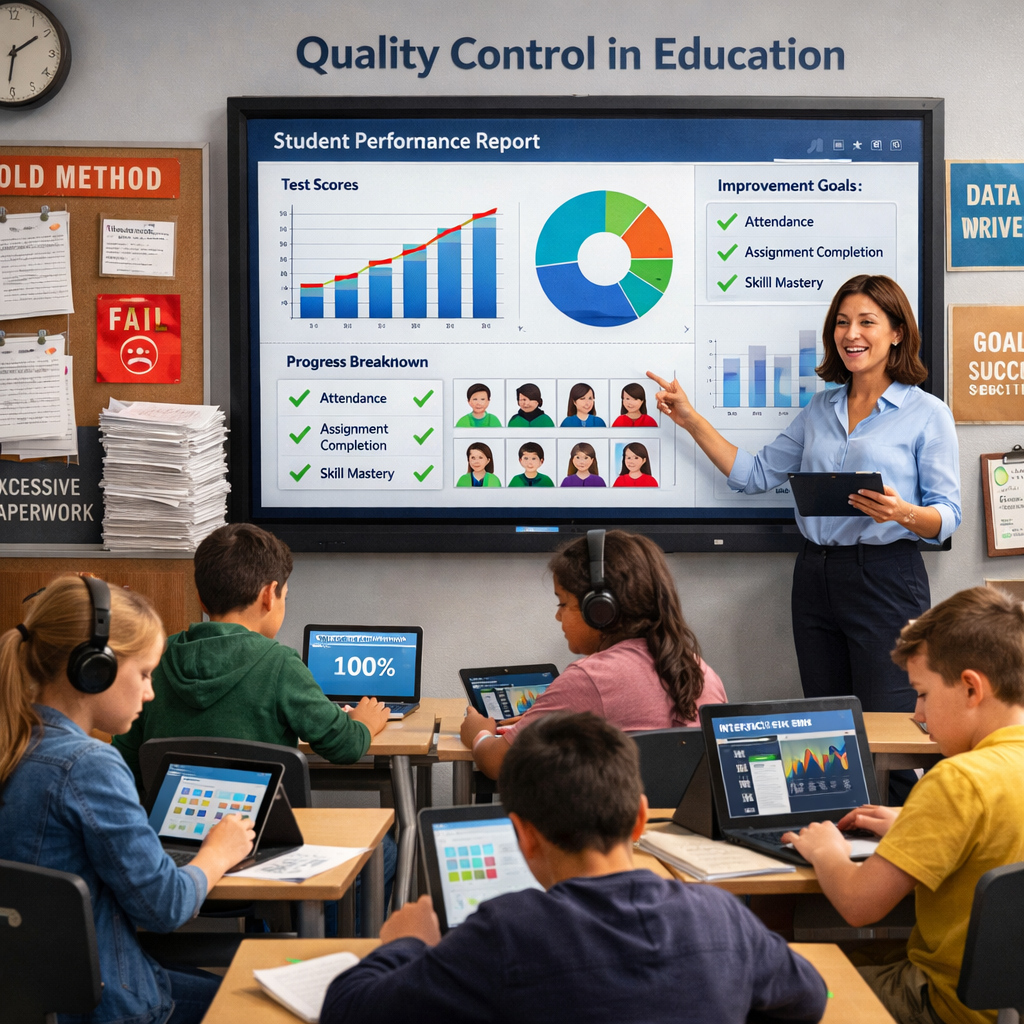
Quality control in education is one of the most overlooked factors in school success. While schools often focus on politics, funding debates, and daily operational issues, they frequently lose sight of their primary mission: educating students effectively.
This is exactly what The Politics of Education K-12 by Lonnie Palmer highlights. Instead of theory, the book focuses on real world problems inside school systems and how better decision making can improve outcomes.
If you want to explore the book, you can check it out here:
https://www.amazon.com/Politics-Education-K-12-Lonnie-Palmer/dp/B0DBGCGGNJ
Why Quality Control in Education Matters More Than Ever
Data Is the Foundation of Quality Control in Education
First of all, quality control in education depends on accurate data. Without data, schools rely on assumptions, which often lead to poor decisions.
In one example from the book, teachers believed that only 60 percent of students were capable of college prep work. However, the data revealed that 82 percent were actually going to college.
Because of this insight, expectations shifted. Over time, 90 percent of students were placed in college prep classes without any decline in performance. Therefore, this proves that quality control in education can dramatically improve results when data is used correctly.
Additionally, research from the Learning Policy Institute supports this approach:
https://learningpolicyinstitute.org/product/how-money-matters-factsheet
Quality Control in Education and Smarter Resource Management
Using Resources Effectively in Schools
On the other hand, quality control in education also involves managing resources efficiently. Since schools never have unlimited budgets, every dollar must be used wisely.
For instance, Palmer describes a case where a school district paid a custodian who had not worked for two years. Instead of continuing wasteful spending, leadership reallocated funds and hired certified teachers who directly supported students.
As a result, student outcomes improved without increasing the budget.
Similarly, data from the Education Data Initiative highlights inefficiencies in school spending:
https://educationdata.org/public-education-spending-statistics
Furthermore, reports like this show funding gaps across districts:
https://edlawcenter.org/research/making-the-grade-2024/
How Quality Control in Education Prevents System Failures
When Politics Interferes with Education
Unfortunately, quality control in education often breaks down when politics takes priority.
In one example, a district was losing $500,000 annually on food services. Although outsourcing could have solved the issue, the school board rejected it to protect local jobs. Consequently, they eliminated kindergarten programs instead.
Clearly, this shows how poor decision making can harm students.
Moreover, research on early education inequality highlights long term consequences:
https://www.epi.org/publication/education-inequalities-at-the-school-starting-gate/
Quality Control in Education Requires Reliable Data
Why Bad Data Leads to Bad Outcomes
Equally important, not all data leads to improvement. If data is flawed or poorly interpreted, it can create ineffective policies.
For example, balanced literacy gained popularity despite limited supporting evidence. In contrast, the science of reading is backed by strong research and measurable results.
Organizations like RAND emphasize evidence based strategies in education:
https://www.rand.org/topics/education-and-literacy.html
Therefore, quality control in education must be built on accurate data and well designed implementation plans.
Quality Control in Education and Real World Leadership
Lessons from The Politics of Education K-12
Unlike many education books, The Politics of Education K-12 is based on real experience. Lonnie Palmer spent over 40 years as a teacher, principal, superintendent, and turnaround specialist.
Because of this, the book provides practical strategies that can be applied immediately.
If you want to explore related topics, check out:
- https://lonniepalmer.com/2026/01/28/education-reform-books-for-teachers/
- https://lonniepalmer.com/2026/01/22/books-on-improving-schools-and-teaching/
- https://lonniepalmer.com/2026/01/09/best-selling-education-reform-books/
- https://lonniepalmer.com/2025/12/22/buy-nonfiction-education-books-with-real-stories/
- https://lonniepalmer.com/2026/01/07/where-to-buy-education-books-online/
- https://lonniepalmer.com/2025/12/10/buy-book-about-education-policy/
- https://lonniepalmer.com/2025/12/01/teacher-professional-development-books/
quality control in education is essential for improving student outcomes, reducing waste, and making better use of resources.
While schools face many challenges, focusing on data driven decisions and accountability can lead to meaningful improvements.
At the same time, The Politics of Education K-12 provides real world examples that show exactly how these changes can be implemented.
Get your copy here:
https://www.amazon.com/Politics-Education-K-12-Lonnie-Palmer/dp/B0DBGCGGNJ
FAQs
What is quality control in education?
It refers to using data, evaluation, and accountability systems to improve student outcomes and school performance.
Why is quality control in education important?
Because it ensures schools use resources effectively while improving teaching and learning outcomes.
How does data improve quality control in education?
Data helps identify gaps, measure performance, and guide better decision making.
What role does leadership play in quality control in education?
Strong leadership ensures data is used correctly and resources are allocated efficiently.
How does The Politics of Education K-12 relate to this topic?
The book provides real examples of how quality control in education can improve schools.